Middletown, DE · Garage Door Service
Panel Replacement for Delaware City's 1960s Garage Doors
Delaware City homes mostly date to the early 1960s, which puts panel sizing and steel gauge out of step with what's sold today. Here's what that means for repair vs replace.
- Repairs & new doors
- Springs & openers
- Serving 7 nearby communities
Doing It Yourself
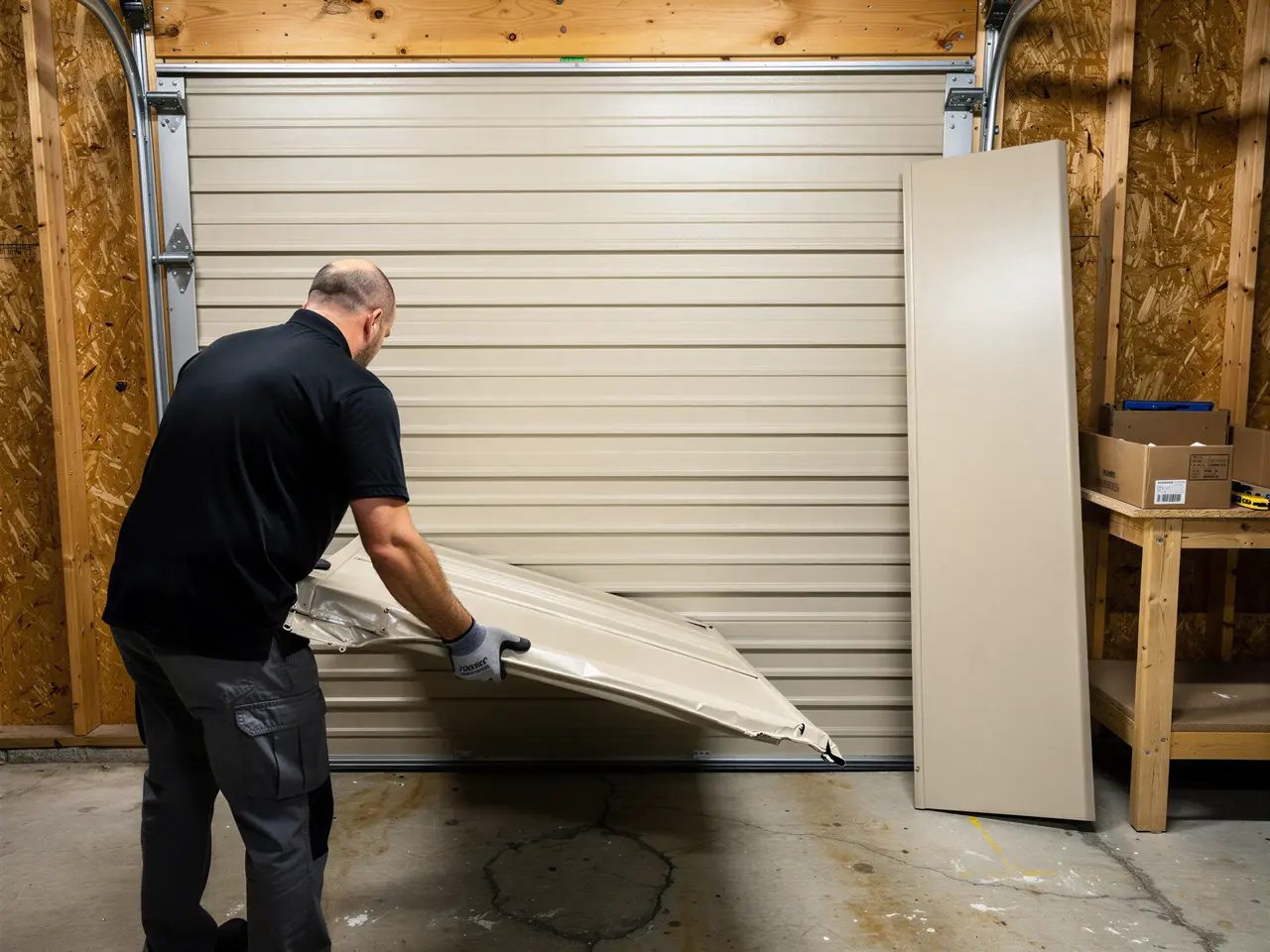
At a median household income of $78,333 here, a single dented or rusted-through panel is usually a repair, not a full door swap - if the door is still in production and a matching panel can be ordered. That's the math most owners are doing before they call anyone: is this a $300-$600 panel job or a $1,500+ new door. The problem in Delaware City is less about the money and more about the door itself. A lot of these houses date to the early 1960s, and a steel section off a 60-year-old door frame doesn't bolt onto a panel ordered from a current parts catalog without some fitting work. You can buy a universal panel kit and cut it to size yourself if you're comfortable with tin snips, a square, and patience. What you can't always do is tell, from the driveway, whether the track and hinge spacing on your door still match anything currently manufactured. That's the part worth having someone look at before you order steel you can't return.
How It Shows Up
On a door built around 1962, panel failure doesn't usually start as a dramatic dent from a backed-into bumper. It starts as surface rust working through from the inside of the steel, especially on the bottom two sections where runoff sits. By the time it shows as a visible hole or a panel that flexes when the door runs, the steel gauge underneath has usually thinned across more of the section than the one rust spot suggests. Cold-climate swings don't help - repeated freeze-thaw cycling works at the seams of an older panel faster than it would somewhere with a milder winter, and that's the band Delaware City sits in. The other common pattern is a panel that's structurally fine but visibly mismatched in color or profile from a prior partial repair, which is its own argument for replacing the full section rather than patching around it again.
The Complications
The complication with a house built in 1962 isn't finding a panel - it's finding one that fits the track and roller spacing a door from that era actually used. Panel widths, hinge spacing, and even the depth of the tongue-and-groove seam changed over the decades, and a current 24-gauge section ordered off a shelf doesn't always mate cleanly with 60-year-old hardware. Sometimes it means replacing the hinges and rollers alongside the panel just to get everything running true again, which changes the cost of what looked like a one-section repair. Severe cold is a second factor: a panel without the foam-core backing that current double-layer steel comes with will transmit more cold into an attached garage, which matters if the space backs onto a living area. We're honest that lead time on a close-match panel for an older door can run longer than a stock replacement - that's not something we can promise around, since it depends on what the manufacturer still carries.
Why This Fails Locally
A generic panel quote assumes a door built in the last 20 years, because most of the service area around Middletown was built between 1945 and 2008 with a lot of newer stock mixed in. Delaware City doesn't fit that average - the median year built here runs closer to 1962, which is a smaller, older pocket of roughly 694 households sitting about 11 miles out from Middletown. That combination means a panel job here is more often a fit-and-match exercise than a catalog order, and a shop that doesn't check the track spacing before quoting will either underquote the job or show up with steel that doesn't hang right. We work from Middletown, so there's no branch stocking Delaware City-specific hardware on standby - any close-match panel order still has to come in before the install date, same as it would for the surrounding towns at a similar housing age, like Townsend or Odessa.
Frequently asked questions
Is it worth replacing just one panel on an older door?
Usually yes, if the rest of the door and hardware are sound. On a 1962-era door the harder part is matching panel width and hinge spacing to what's currently manufactured, not the repair itself. If more than two sections are compromised, a full door often ends up costing about the same as patching section by section.
Why does my panel keep rusting from the inside?
On older steel doors, moisture gets trapped between the panel skin and backing with no drainage path, and repeated freeze-thaw cycles through the winter push the rust along faster than a one-time dent would. It's a known pattern on doors from this era in a cold climate, not a sign you did anything wrong.
Can you match the exact panel profile on my door?
Often, but not always, and we won't quote a match we haven't confirmed against your track and hinge spacing first. On doors from the early 1960s, that confirmation sometimes means a longer lead time while the manufacturer sources the closer match.
More garage door services in Delaware City
Book garage door service in Middletown
Call now or request a quote - tell us what the door is doing and where you are.